Showing posts with label Repatriation. Show all posts

Medical Evacuation: Saving lives, helping families

Chris Hutton and his wife Julie 
A first-year med student didn’t know that his family membership with AirMed would come into play one day in early 2014

Sandy Kinkade Hutton has been an AirMed member for the past eight years. When she married Kevin Hutton in 2011, she added both her husband and stepson, Chris, onto her membership.

Chris Hutton is a first year med student at American University of the Caribbean located on Saint-Martin island in the Caribbean. Chris had experienced inability to urinate for several days, and finally made a decision along with his wife, Julie, who is a French citizen, to go to the local hospital to be checked by a doctor.

During what would be fairly routine treatment in any metropolitan medical center, the island medical staff was unable to place a catheter and traumatized Chris’s urethra. Then they managed to slice off a segment of a plastic catheter inside Chris’ bladder. His situation went from bad to worse within hours with concerns of peritonitis mounting. “The island surgeon said he had sliced off the tip of the catheter.” It wasn’t until we were back in the U.S. that the urologist told us it was a foot long piece of catheter,” Sandy said.

After the “oops” moment with the catheter, the Hutton’s knew they needed to get Chris off that island and to a higher level of medical care back in the United States. Sandy told him to make the call to AirMed.

Once the call to AirMed was made, AirMed put its operation in motion. “We talked to AirMed the entire time. We heard from them through email and through phone calls, they kept us informed every step of the way,” Sandy recalls.

Chris states "Lying in pain in a bed at night there at the island's hospital, it was the worst feeling, to feel a million miles away from home. Once the crews arrived, everything changed. I knew from the instant they walked in that I was safe, and on the road to recovery."

AirMed arrived, and Chris was transported to the University of Miami Hospital early the next morning. Because it was an international flight, U.S. Customs came to the ramp to check all passports. Chris was transported by ambulance to the hospital. “AirMed even arranged for a taxi to take Julie to the hospital when she was finished with Customs. It was just a level of completeness—AirMed saw to it that nobody was left stranded.” said Sandy.

Chris was taken into surgery in Miami to remove the catheter and assess the situation. A new catheter was inserted and remained in place for 3 days. It was removed, and Chris and Julie were able to return to St. Martin to resume his medical school studies with a new understanding of what it is like to be the patient.


Kevin and Sandy Kinkade Hutton
“The thing that makes this entire event even more remarkable,” Sandy continued, “is that I was a flight nurse for 13 years, and Kevin was a flight physician. I am a past President of the Association for Air Medical Services (AAMS), and Kevin is the current Chairman of MedEvac Foundation International. We really know this industry, inside and out. Neither of us ever, in a million years, thought we’d need to use our AirMed membership. It was SUCH a relief knowing that one call took care of everything.”

“As a flight nurse, I remember arriving at hospitals and the sigh of relief on people’s faces when the flight crew would show up,” Sandy said. “For the first time, I was on the other end of that scenario. I was on the patient side, and I knew professionals were on their way to get Chris off the island and that they were fully able to take care for him. It was such a relief once I knew the medical crew was on that island.”

Dr. Kevin Hutton added, “We want to really stress the fact that you never think it’s going happen to you. You simply never know when something like this will happen. Had we not had the AirMed membership, we’re not sure how this whole thing would have transpired.”

Sandy said, “I’ve seen so many times where people think their health insurance will cover this type of thing and it doesn’t. I’ve kept my AirMed membership all this time because you’d like to think that healthcare is good everywhere, especially on an island known for attracting tourists, but it is not.”

Chris and his family knew that AirMed had their back. Since he’s been back at school, Sandy has helped Chris write a protocol for the medical school he attends to try and put some sort of medevac membership policy in place. “ In the event of a medical emergency such as this, being prepared is the key,” she said. Chris commented, "I don't know what we would have done without AirMed membership. I am so grateful that my family is covered for the future."


Kevin added “We will NEVER be without an AirMed card.” Several of the Hutton’s family members are also new AirMed members.

When a business trip turns deadly: how one man made it home alive

Cliff Hawk, owner and president of Texas company KnightHawk Engineering shares the remarkable story of his near-death experience and the AirMed transport that helped get him the care he desperately needed.

"WHERE AM I?"
I suddenly awoke in a hospital bed and immediately noticed everyone was speaking in a language I did not understand. Then to my surprise my two boys and wife gathered around the bed side. I was on a ventilator and could not speak. My wife and sons started relaying the events that had occurred, starting with:

“You are in Seoul, South Korea in the University Hospital.” The story unfolded over the next week, and to this day, I can’t believe the story was about me and the struggle my family had.
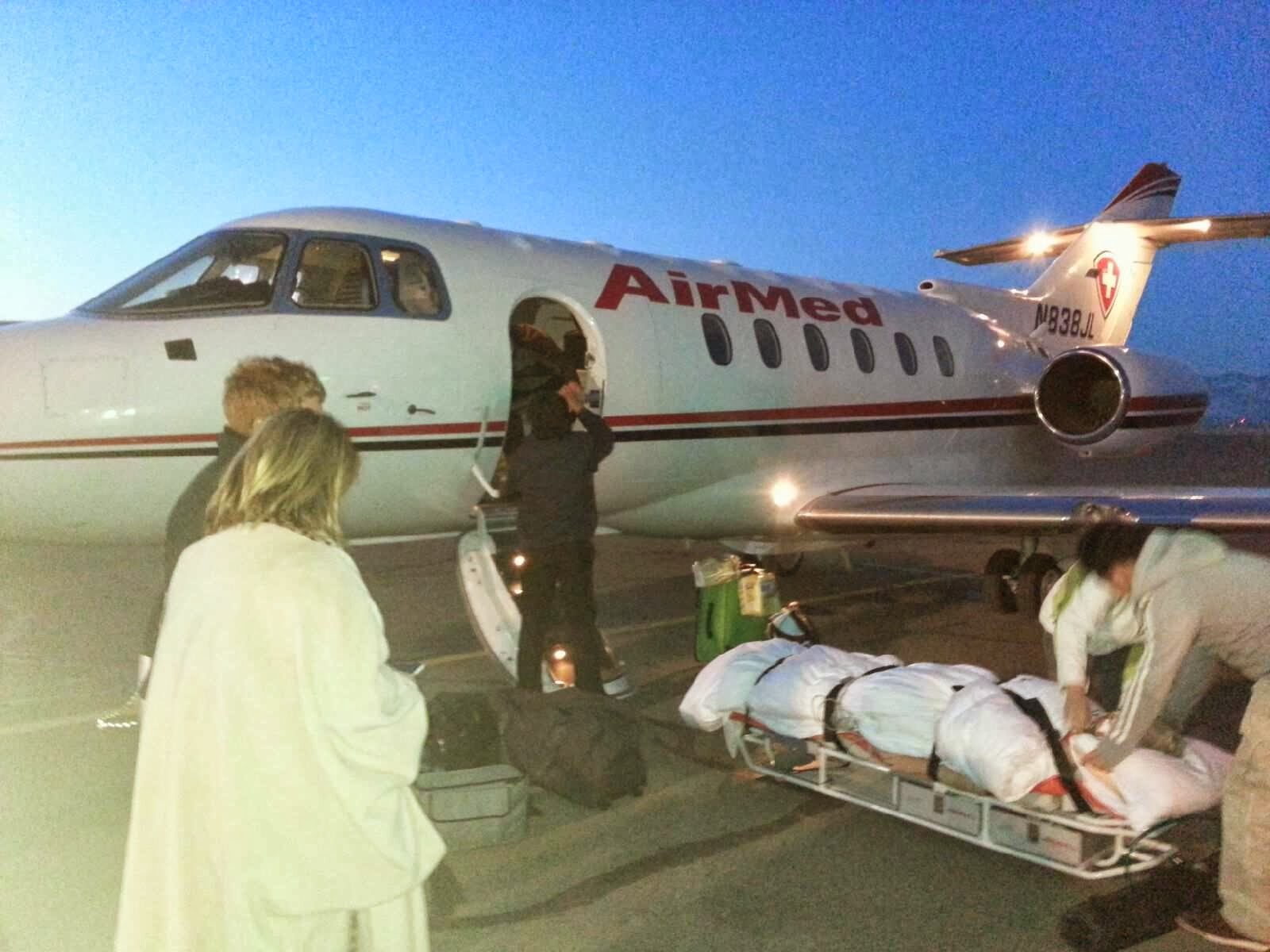
Mr. Hawk shared this photo of him being taken aboard
AirMed's Hawker medical jet en route to Seoul, South Korea

Traveling for my company, Knighthawk, I arrived in Ulaanbaatar, Mongolia (UB) the capital city, at Genghis Khan Airport, then boarded a company plane for a 2.5 hour flight out into the Great Gobi Desert. The job site was at one of the largest copper and gold mines in the world. I started feeling under the weather, and the next morning I decided I better go to the site clinic. Within a matter of hours I had high fever, and it was decided that I must be air evacuated to a major clinic.

"I GOT WORSE."
All of my major organs began to shut down. The Mongolians called the U.S. embassy to start paperwork to transport my body to Houston. They told my wife and sons that I would die, but my wife and family refused to accept it.

My wife injected her knowledge with the help of Houston doctors into the situation.
Changes were made and against the Mongolian doctors’ advice, my wife and sons made the prayerfully thought out decision to life flight me via AirMed to Seoul, South Korea.

GETTING HOME VIA AN AIRMED PLANE
I arrived into Seoul at death’s door, and was immediately taken to the Seoul National University Hospital and put into the Intensive Care facility. I made it through the night and in four days had another major surgery. Soon, my vital signs went to normal, and the doctors said I could be medically evacuated back to Houston.

The last conversation with the doctors in Seoul the night before I left was surreal. “We have no idea why you are still on this earth and how you recovered.”

After six ambulance trips, two major surgeries and two air evacuations, I made it home to Houston alive. Study my story and realize that things can change in a moment. Thank you to AirMed and the rest of the people who helped to save my life.  --Cliff Hawk

Transporting a comatose patient, complicated issues arise


DULUTH, Minn. -- Pakistani officials agree with the family of comatose Pakistani student Muhammad Shahzaib Bajwa that he should remain at Essentia Health-St. Mary's Medical Center for treatment.

"That's what we have said is give this boy a chance, because definitely the medical facilities here are much better than in Pakistan," said Faisal Niaz Tirmizi, the Pakistani general consul in Chicago.

But as of Friday, exactly two weeks before Bajwa's student visa will expire, the U.S. State Department still hadn't answered the consulate's request that Bajwa's stay be extended until his condition stabilizes, Tirmizi said.

The recovery to that point could take more than a year, said Bajwa's brother, Shahraiz Bajwa, in an interview earlier this week.

Shahraiz, 22, who immediately flew to the United States from Pakistan after learning about the accident, wants his brother kept at St. Mary's because of the superior quality of care here, he said this week. But he's also concerned that his brother might not survive the long flight.

That's possible, an official for a company that specializes in such flights said.

"We don't have data about deaths in flights, but it has happened, yes," said Sarah Hanley, director of corporate communications for Alabama-based AirMed International.

AirMed, which transfers all international patients for the Mayo Clinic, has transported patients who were in comas, Hanley said. And distance is not an issue.

"We have transported patients from Minnesota to places such as Pakistan, or vice versa," Hanley said. "It is possible and done quite often, transports of that long-distance scope."

Read reporter John Lundy's Full Article here.

What if you need medical evacuation?


There isn't a traveler alive who thinks they will be calling an air ambulance at the beginning, middle or end of their trip.  Whether it's a business trip or a bucket list vacation, no one expects to have an accident or be struck with a serious illness while they are away from home. That is where AirMed comes in.

Your health and safety means the world to us

If you become ill or injured while traveling, AirMed will safely deliver you to the hospital of your choice. If you receive a serious health diagnosis and don’t know where to turn, AirMed is there for you, coordinating every aspect of a medical or second opinion referral. This and so much more is the assurance AirMed offers to our members. We strive to be more than just a card in your wallet; we are your peace of mind.
  • We cover every trip you take even domestically.
  • You don’t have to be critically ill or injured to qualify for a flight.
  • There are no deductibles, claim forms or out of pocket expenses.
  • Pre-existing conditions are accepted.
  • There are no financial limitations for medical transports.

More than simple travel insurance


AirMed is an important enhancement to existing health and travel insurance. Most insurance policies focus on trip cancellation and lost luggage. AirMed focuses on taking care of your healthcare when you need us most. In other words, we save lives, not luggage.

AirMed memberships protect your most important asset: your health. In the midst of an emergency or serious medical diagnosis, reliability and cost should be your last concern. AirMed provides you access to an unsurpassed quality of care, every day of the year.  Find out more about air medical memberships that cover you for one trip or all year at airmed.com 

Delays in U.S. Airport Customs Take Economic Toll

Hurry Up and Wait.


The time spent in Customs lines in U.S. airports equates to an economic loss of $416 million annually, according to a study just released by the United States Travel Association.

The report, entitled “Gateway to Jobs & Growth,” examines the effect the U.S. entry process has on the U.S. economy. Some of its other findings include an estimated 2.7 million international travelers do not even attempt to cross U.S. borders due to perceived or, in some cases, actual red-tape involved in the Customs process. The USTA estimates this translates into a 11.1 billion economic loss.


In addition to identifying current problems, the study contains 20 policy recommendations on how to improve the entry experience for international travelers coming to the U.S. and to better support hard-working officers at Customs and Border Patrol (CPB) who strive daily to keep our nation secure. 

The U.S. Travel Association’s report proposes hiring an additional 3,500 Customs officers and implementing new technology to reduce peak wait times by 50 percent and process each international traveler within 30 minutes of arrival. The findings were compiled in a letter to Congress and signed by prominent travel industry executives.

The average Customs wait time at the Miami International airport is 4.48 hours.

Important Documents - Where to Store Them When You Travel

Travel Tips: Always keep a digital back up of your passport

Travel tip of keeping extra copy of passport

AirMed membership benefits include free international legal referrals, emergency call relay and 24/7 medical services hotline for referrals to English-speaking, Western trained doctors.  Find out more at airmed.com.


Inside the World of an International Flight Dispatcher

Dispatches from the Air Medical Field

The dispatchers at AirMed have their fingerprints all over flight operations for the company. Lead Dispatcher Jason Garcia took some time to tell us about the department and their important part of the air medical process.

by Jason Garcia
Lead Dispatcher at AirMed International

I actually had never heard of flight dispatching until a few months before I was enrolled in a flight dispatch class working on my certification. Fresh out of the Army and living off the generosity of relatives, I somehow completed the course with no problems and found myself looking for my first job as a flight dispatcher in the wake of 9/11. I had received my dispatch license only one week prior to September 11, 2001. After stints in Wichita and Cleveland, I came to AirMed in 2004 and have been here ever since.

AirMed dispatch office
Dispatchers deal with weather, air traffic, visibility issues,
customs issues, flight planning, pilot staffing, and
have a host of other unsung talents that help AirMed's
air medical flights operate smoothly.
AirMed dispatch combines every possible aspect of planning and logistics for our long-distance and domestic medical transports. Besides the flight planning and weather checking, we spend much of our time dealing with foreign handlers and customs agents all over the USA and abroad.

In today’s modern aviation environment there exists a huge list of little things you need to keep track of in order for trips to run smoothly. I have described my team of dispatchers as the busy legs that keep the duck looking so serene and relaxed on the pond…only this pond is full of alligators, red tape and rapidly changing requirements from other countries. Needless to say, I rely heavily on local handling agents to keep everything running properly and to make sure that our patients are brought safely home and that we exceed all their expectations.

Here at AirMed we only hire certified Part 121 flight dispatchers. That means they have passed the FAA Flight Dispatcher’s course and have been issued an FAA dispatcher license. The course includes classes on flight planning, aircraft performance and lots of instruction on reading weather forecast and condition reports. That sounds simple enough, but no one breezes through Dispatch School, and it is not uncommon for people to know the exact score they received on the final exam literally decades after taking the test. (I got a 92.)

Being a successful flight dispatcher requires a few other talents. All good dispatchers are organized and use their experience to plan ahead a few steps. I can always tell when a new dispatcher is progressing well in their training by the level of questions they ask. Not the number of questions, but rather the complexity of the question, such as how a single aspect of a trip can affect the success of the trip as a whole.

In the end though, every trip is different. To be successful, I am constantly rolling with the punches and playing them as I see fit. Sometimes I believe that I can expect a day where there could be no surprises and have it complicated with a typhoon or Israeli sorties in Lebanon or both. In those cases, a sense of humor may be a dispatcher’s most valuable commodity.

Over the years I have learned that no matter how deep the hole I find myself standing in, I always somehow find a way to make things all work out. Focusing on the trip and reminding myself and the dispatchers that someone is relying on our team to get them home after they hurt themselves while far from home is paramount. “Who better than me to get this person home to their family.” I actually say that to myself sometimes, and it works.

When the patient is delivered and the crew is on their way back to our home base, I enjoy a victory meal. The McDonalds by my house is open all night...they know me.


What to Know When Civil Unrest Strikes When You Travel

AirMed Provides Members with Security Assistance Around the Clock

You can rarely turn on the news and not see video or a news story about civil unrest happening somewhere in the world. Riots, demonstrations, and terrorist activities can occur anywhere in the world, especially in largely populated cities.

AirMed can and does provide assistance to our members if a crisis erupts. AirMed has close connections and agreements with multiple international security firms who specialize in up-to-the-minute security information and getting people out of harm’s way.

Should you, as an AirMed member, become trapped in a dangerous situation where civil unrest is occurring near you or in the city you have traveled, AirMed will get you the necessary information you need and even make arrangements to evacuate you to a designated safe haven or city or location away from the danger.

If you happen to become caught in an unsafe situation, our members can contact us, and we will act as liaison between the member and the security firm, ensuring that you receive the information and assistance you need. Our contacts are experienced in getting people critical information, most even have “boots on the ground” ready to assist in a timely manner.

Travel Warnings are issued when long-term, protracted conditions that make a country dangerous or unstable lead the U.S. State Department to recommend that Americans avoid or consider the risk of travel to that country. A Travel Warning is also issued when the U.S. Government’s ability to assist American citizens is constrained due to the closure of an embassy or consulate or because of a drawdown of its staff.

All of the steps and information AirMed provides to assist you during an unstable situation are there to add to your peace of mind while traveling.

For up to the minute alerts, visit travel.state.gov.
Or, become an AirMed member and have 24/7 access to our
security and travel assistance. airmed.com.

Worldwide Heart Attack Stats

Heart Failure Can Happen Anywhere

Heart attack statistics

AirMed memberships will bring you home to the hospital of your choice if you are hospitalized while away from home. Find out complete details for your family, at airmed.com. 

Vintage Air Ambulance PBM-3S Mariner

 Nostalgic About Air Ambulances? 


PBM-3S Mariner Air Ambulance
Early Emergency Air Evacuation


Wartime publicity photo highlighting the air evacuation capabilities of the PBM-3S Mariner.  From humble beginnings...


Airmed Hawker 800
Check Out Our Updated Fleet

Find out more about the latest in fixed wing air ambulance transportation by visiting us at airmed.com


Air Medical Transport Facts from AirMed

Get to know about air medical transports with AirMed

Air medical transport

FACT:  80% of AirMed transports are within the continental United States

  • We own our own aircraft; all aviation and medical personnel are AirMed employees. Complete vertical integration sets us apart in the industry, in fact, most travel insurers call on us to move their patients.
  • With AirMed, the choice is always yours. Travel insurance will not get you home, only to the ‘nearest appropriate facility’ chosen by them. AirMed brings you home, to your doctor, your family, where you want to be.

FACT: The cost of a regional medical transport is approximately $22,000. The cost of an international transport can rise above $200,000.

FOLLOW UP FACT: 100% of our patients who have had to pay this full bill immediately become AirMed members when they return home. Retail cost of an annual AirMed individual membership: $265.
  • Saving lives and bringing you home. AirMed brings you back home to your local hospital or to the hospital of your choice. Think your health insurance will cover air medical transportation? It won’t.
FACT: 25% of all AirMed member transports are to specialty facilities.
  • Evacuation and Repatriation from any point on the globe, even as close as 150 miles from home
  • Domestic Transports if you need specialized treatment at a hospital in another city
  • 24/7 Medical Hotline for emergency physician consultation while traveling
For more information, check out AirMed.com

What do you do when a loved one dies while away from home?

Transporting Deceased Loved Ones

An AirMed member wrote to us recently with the following story, "Two years ago, my uncle died unexpectedly while we were on a family vacation in Orlando. No one in my family had the first clue about transporting him back home to Illinois. Can you tell me more about AirMed’s benefit of transporting mortal remains?"

transporting a bodyTransporting a loved one who has died while away from home is truly one of the most daunting situations any of us could ever entertain in theory, let alone face in actuality. The questions and details seem endless amidst the grief process itself. That’s why all of us at AirMed know the importance of being there for our member and for everyone else involved during such an extremely emotional time. 

We offer the deceased transport as a member benefit for just that reason.  When a loved one dies, the deceased must be taken to a licensed funeral home or mortuary before being transported elsewhere. AirMed’s medical coordination staff is available by phone 24/7 to give you complete assistance with any part of this process, from whatever city you may be in.

As an AirMed member, we will manage all efforts for you, between ground transportation, funeral homes in different geographic locations, and any other arrangements that must be made, and we will keep your family informed during the entire deceased transport process. AirMed has transported mortal remains on our own aircraft but also on commercial aircraft, depending on individual family needs, but you can always rest assured that we will coordinate every detail to bring them to their final resting place.

A repatriation situation—when someone dies in another country—is handled a little differently depending on the laws governing the city and country where the death occurred. The term repatriation literally means ‘to send someone back to the country that is their own.’ In this circumstance, AirMed would arrange the same ground transportation and other details from a domestic transfer, but would also obtain the necessary documentation for the deceased to cross international boundaries.

We extend our sympathies to you and your family on the loss of your uncle. Thank you for taking the time to inquire about this important and too often overlooked benefit of being an AirMed member.

Dennis Scott, MD
Medical Director, AirMed International 


AirMed is the premier global air ambulance and medical solutions company that protects your greatest asset: your health. Within the U.S. or internationally, an AirMed membership includes air medical transport to the hospital of your choice with no co-pays or out of pocket costs. AirMed also includes a host of other benefits ranging from transport to a domestic facility that specializes in life-saving treatment, referrals to leading medical consultants, international prescription assistance and more. For more information, visit airmed.com